Saturday, November 30, 2013

The World Within You.


Buddhist principle oft-revisited is that there exist two worlds: the externalized world, as well as the world internal. One world exists apart from your lament. Thunder storms will happen on wedding days. Tornados tear houses built by hand over years asunder. Sun wears down car interiors. In Buddhism, the idea is to be at peace within, and then without. First acquiesce to this understanding that nothing can change your inner world unless you let it change. You control the breath, you are ever the gatekeeper of your disposition. Nothing breaks this down except for you. You are the alpha and omega for the unassailable or fragile nature of your being.

And once you have taken hold of this understanding of the intrinsic world, address the outer world. The rainy day did not ruin your Saturday. You let the rainy day ruin your Saturday. The ultimate onus: extreme personal accountability, even of those things which you cannot control.

In Infinite Jest, the head coach of the Enfield Tennis Academy is Gerhardt Schtitt, a german native who is densely and uncompromisingly philosophical, even when his players suffer during A.M. drills. Below is a passage from Schtitt following a grueling A.M. drill during frigid Boston temperatures.

Adjust. Adjust? Stay the same. No? Is not stay the same? Is it cold? Is it wind? Cold and wind is the world. Outside, yes? On the tennis court you the player: this is not where there is cold wind. I am saying. Different world inside. World built inside cold outside world of wind breaks the wind, shelters the player, you, if you stay the same, stay inside. 
What will it be this time that you blame? The cold? The wind? The heat? What will it be? He continues.
Not ever I think this adjusting. To what, this adjusting. This world inside is the same, always, if you stay there. This is what we are making, no? New type citizen. Not of cold and wind outside. Citizens of this sheltering second world we are working to show you every dawn, no? To make your introduction.
This is no simple task if you've ever tried your hand at it. To remain within, to resist the temptation to blame externalized factors. When you are immersed in a culture where so many people do it and claim victory by this means - you need only look so far as the litigation-happy climate of the United States - it is tantalizing to relinquish the inner world and point the finger outwardly.

This second world inside the lines. Yes? Is this adjusting? This is not adjusting. This is not adjusting to ignore cold and wind and tired. Not ignoring “as if.” Is no cold. Is no wind. No cold wind where you occur. No? Not “adjust to conditions.” Make this second world inside the world: here there are no conditions.

Or else leave here into large external world where is cold and pain without purpose or tool, eyelash in eye and pretty girl – not worry anymore about how to occur

And so Schtitt addresses the why. Why struggle so hard to maintain the scope of the world within us? The reason becomes obvious once you participate in the outer world. The world where you are helpless to the forces of cold, heartache, eyelashes in the eye and pretty girls to make you falter. If you want to vacillate spinelessly in the world and be subject to the perils of these entities and so many more, then do so. Yet there is always an option to exist within oneself, unswaying and unnerved even when nothing goes right. When all favor has eluded me and I am left only as this flesh hull with but a dull thud emanating from my chest, I am still so much more. I can still be centered, I can still burn with strength. I can still forge my own way, manufacture my own luck and fortune again and again in the future. The world within is an everlasting wellspring of purpose.

Or simply be crushed beneath the weight of what you find to be reality. Still, it is your choice. It is because of this choice that you are human in the first place. Your adherence to this world or that world may be what finally orients you to either greatness or faceless unremarkable ennui.


I made a new playlist on 8tracks. The description of it is within the link, if you'd like to have a listen.


Until next time. 

Monday, November 25, 2013

How Books Become Me


Throughout this life I've read many books. The most memorable books synthesize, unbeknownst to me, and become part of who I am. Books change how I view the world around me and they change how I view myself. Pinnacle moments are those where I set the book aside, gaze idly at the ceiling, and allow myself to acquiesce to the acknowledgement that a book has changed me.

This synthesis is fascinating to me, just as humans are amazing as well. That we can pick up a book, so full of words and effort and sentiment, and assimilate its contents with resultant change in who we are is simply amazing.

Below I've listed some of my favorite books, particular quotes which shook me or at least faintly resonated, and what the quotes mean to me.


"Norwegian Wood" by Haruki Murakami


I've read "Norwegian Wood" three times. I identified with the book almost immediately. The protagonist, Toru Watanabe, is a book-loving introvert; a recurring theme in Murakami's books. It was recently adapted as a movie, but a certain peril became of the movie which is commonplace for film adaptations: pieces were missing. I digress. Quotes.

"Don't feel sorry for yourself. Only assholes do that." Nagasawa, to Watanabe.

This is not an incredibly profound quote, but it struck me nonetheless. I've never derived merit of any sort from periods of self-pity. An ugly truth in this world is that no one, aside from the small circle of truly intimate friends and family, truly cares for your struggles or purported swan song. The less time spent brooding over your own misfortunes or perceived misfortunes, the better. Far better to foist yourself unto your next effort, and it's always made me feel better to simply start working toward a new goal rather than clamber in the wake of a recently failed goal or relationship.

“But who can say what's best? That's why you need to grab whatever chance you have of happiness where you find it, and not worry about other people too much. My experience tells me that we get no more than two or three such chances in a life time, and if we let them go, we regret it for the rest of our lives.” 

Ever been completely absent in the midst of what should have been a happy moment? Be here now, and fiercely so. If it makes you happy and it won't harm anyone else, then don't think too much about how others will feel about it; enjoy. We're all positioned along this timeline of being alive with no certain grasp of when the timeline ends; the more time spent genuinely enjoying what you love, the better. One less death bed regret.


"Infinite Jest" by David Foster Wallace


Still in the midst of this prodigious literary effort. Still, there are enough quotes I've tripped over that have left their mark. Sometimes I feel like this entire book is one big transcendental quote.

"The truth will set you free, but not before it is finished with you."

Much of David Foster Wallace's literary value comes from his ability to pierce the veneer of casual lament and invade psychic space that you thought was yours, and yours alone. As in DFW has been skulking about your psychic quarters and rest lamplight on the darkest corners. 

This quote reminds me of a scenario where two people are in love, and while one of the lovers is away from home, the other lover is sifting through the closet, until this lover finds the journal of the other lover. The lover knows that reading this journal will hurt - because we all know that the purpose of journals is to house those painful truths which can't live sustainably well in open air - but goes on and reads the damn journal anyway. Predictably the person becomes hurt, even though he/she knew this would be the outcome. The truth is like that: the very best lessons in life bury their stinger deep into adipose tissue and you can't just scrape the damn barb out. It will come out when it's ready. You'll be better and wiser in the end, but not without the requisite amount of suffering enveloping you first.


“That sometimes human beings have to just sit in one place and, like, hurt. That you will become way less concerned with what other people think of you when you realize how seldom they do. That there is such a thing as raw, unalloyed, agendaless kindness. That it is possible to fall asleep during an anxiety attack. That concentrating on anything is very hard work.”

This quote is part of a much larger passage, all of it armed to the teeth with keenly sharpened truth daggers that penetrate the perfunctory psyche that's necessary to trudge through the menial times. I haven't directly experienced the panic attack, but the rest of this is absolute resonant truth. 


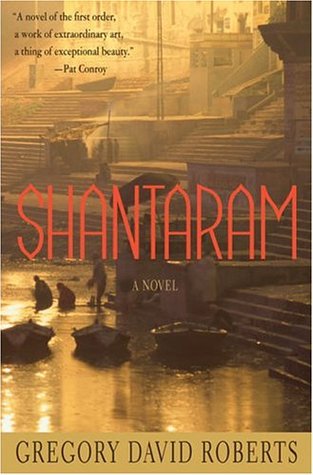
"Shantaram" by Gregory David Roberts


I loved Shantaram so much upon completing it (another fairly long read) that I forced it upon many of my friends as a Christmas gift. Hopefully they enjoyed it, those who bothered to read it. Shantaram is really just a book about life, but it takes place in India and pulls no punches, makes no provisions to romanticize the country - yet at the same time these grimey depictions are also what make it that much more endearing.

"I don’t know what frightens me more, the power that crushes us or our endless ability to endure it."

This quote is about mankind's inherent attributes: to exploit, manipulate and oppress the people we should care about, and the ability by those on the receiving end to just endure it, and emerge from the other side of that experience and one day again smile so hard it splits the corners of your mouth, or just laugh so hard you pee yourself just a little - a dignified amount of laughter-induced micturation. This quote has presented it as a truth to me both firsthand and in reading, and it's a microcosm of what it means to be human, to me. The fiercely selfish and evil desire to win out regardless of who it may destroy, and then in turn the ability of humans to just withstand it. Sometimes it all gets stripped away and you're left with nothing but a flesh hull, something beating inside, and your posture. And then the future continues to unfurl before you and things get better, and one day you look in the rearview mirror, appraise that time you were crushed, and think to yourself, "how the hell did I make it through that?"

“Sooner or later, fate puts us together with all the people, one by one, who show us what we could, and shouldn’t, let ourselves become. Sooner or later we meet the drunkard, the waster, the betrayer, the ruthless mind, and the hate-filled heart. But fate loads the dice, of course, because we usually find ourselves loving or pitying almost all of those people. And it’s impossible to despise someone you honestly pity, and to shun someone you truly love. ” 
The best action we can take in beholding the mistakes of those around us is to honor them by not making those same mistakes. And I find it true: you can't hate those you pity. And you can't truly shun someone if you love them, and love is genuine. A flaw is just as much a part of a person's composition as any accomplishment they've ever had.

And now to depart from books and dive into my other favorite subject: music! Random array of music below.


I've played this long a lot recently. After seeing Bassnectar live, I now hear the songs and think to myself "I know what this song feels like." And I smile.


Seven Lions is establishing a musical identity in the darker corners of electronic music. He's making it his style and I'm enjoying it thoroughly.


Digging some Swim Deep recently.


The Weeknd's take on "Odd Look" by Kavinsky is spectacular to me.

Enjoy. And, until next time.

Saturday, November 23, 2013

Array of Updates.


When I'm not working or at the gym or running or sleeping, I'm reading. Relegated to a lifestyle recently that borders monastic. Infinite Jest, a behemoth of a novel and David Foster Wallace's magnum opus, has consumed me. Referred to infrequently or perhaps frequently (depending on which dark corners of the internet or the real world you frequent) as the modern day Ulysses, Infinite Jest is accused of being a pretentious read. I can see that.

What started as a clambering effort to get the literary wheels turning now flows freely. I was for a time having to put forth sincere effort to feel anything emotive for the book. This all seemed to evaporate without my knowing perhaps 200 pages in. I acclimated to the voluminous diction DFW employs, and I adapted to the monolithic 500+ word run-on sentences that sometimes outlasted the pages they were written on. Furthermore, character depth can only increase over time when performed artfully, and DFW is nothing if not artful. 

What seems interesting, as I read this book, is this: David Foster Wallace battled addiction and depression throughout his life, as is clearly apparent in this book, but he wrote Infinite Jest during a period of abstinence from substances. This makes sense to me, when I read the abundant clarity in his writing. However, more interestingly, this book DEMANDS that you be sober to read it as well. You simply would not be able to absorb the content elsewise. And so once you are interested in this book, and make it your priority, you would as a result shelf any vice you may have in order to comprehend the text.

Interesting!

I just purchased a chunk of music, the lineup of which pleases me. Have a gander if you want.


Until next time.

Sunday, November 10, 2013

What You Don't Know About Iraq


It was five AM when I stepped out onto the street in front of my apartment in Atlanta. I was
awaiting a cab I requested by phone to take me to the airport, where I would depart once
again and begin the process of working internationally. When my cab arrived I was greeted
by a radiant gentleman who originally hailed from Somalia. Recent brushes with Africans
have rendered me infinitely curious about the culture of various nationalities within Africa.
Assuredly, I have had mainly positive experiences in the past, and this encounter would
prove no different.

En route to the airport, the conversation with my driver started not unlike most conversations
with complete strangers. He disclosed that he is from Somalia, and then went into detail
about Somalian life, including the ever-present violence that comes with trying to
establish some semblance of a proper government upon a people who previously
weren't accustomed to such an initiative. He went on to describe the tribal conflicts and
bloodshed which still occur in Somalia, to this day. 

Knowing most northern African countries are comprised of Muslims, I asked if
most of Somalia practiced Islam, and my cab driver confirmed that they do. Beyond
that, he went on to explain the black eye that September 11th created for Muslims
worldwide, and how distressed he was at that perception. At this point he was relating
what I already knew: Muslims, by majority, want to live a peaceful and good life.
Truly, they have the same hopes and fears as anyone else in the world. The true
shame occurs when the radical minority becomes globally sensationalized.
What you're left with is a religion now unjustifiably rooted in stigma. If I had to
guess, I would suspect that this stigma will persist for quite some time. Some
wounds simply take decades to heal, and even then it will never be forgotten.

So we arrive at a very familiar place: Iraq. The Iraq you think you know and the Iraq
that exists in reality are really quite disparate. While the violence is ever-present, and
the country has seen more bloodshed this year than in five years prior, there is something
that must be known: these people, by and large, aren't unlike you and I. They are kind,
giving, and they work hard. They are not entitled to the same stipends found in Qatar, Kuwait,
or UAE. Iraq is a struggle perpetually. 

For an idea of the reality of Iraq, please read this link which chronicles the violence
in Iraq, year to date. It's not pretty. It's gruesome, and it's unfathomable. In any one
incident, scores of people are killed, many more injured. Typically the setting is a
public place of high density, such as markets or mosques. 

It should be understood that while the government is making efforts toward democracy
(at least on paper - again, if you read the article you will quickly find that corruption
and sectarian government are causing ongoing issues), certain inexorable differences
are still in place, much as they have been for centuries.

Prior to the death of the Prophet Muhammed in year 632, there was no stark divergence of
Muslim faith. Upon his passing, the Muslim faith bifurcated. The Sunnis believed that
the new torch-bearer should be Abu Bakr, who was Muhammed's adviser prior to his
death. Contrarily, Shiites aligned with Ali, Muhammed's cousin and son-in-law.

The inner turmoil truly manifest in year 656, when the third caliph, exalted by the Sunnis,
was killed. Shortly after, in response, the Sunnis killed Ali's son Husain. This
is an incredibly abridged synopsis that brings us to present day. A fundamental rift between
Sunnis and Shiites as to the proper way to carry on their faith. Yet even before this
divergence, violence has existed in Iraq, essentially since civilization was established. It is
worth mentioning that there have been prolonged periods of empire and prosperity, but
with upheavals and wars always creating a paradigm shift.

Though there is violence, I feel that the worldwide ire (especially from the West) is undue.
It would suffice to regard present day Iraq as a tragedy, but enmity doesn't do anything to
further matters. I'm without answers when I ponder what it will take to finally seals these
old wounds, of course, and I can only naively offer that it's going to take time - a lot of time.

As I mentioned in a blog post last year, Iraqis are genuinely very nice. Quite literally,
they would offer the shirt off their back to you if they saw you needed it. Ingrained in
the five pillars of Islam is zakat - and inherent belief in charity and giving. The belief
underscores a mentality that wealth is a waste unless shared.

If anything, and if you're still reading, I would implore you to exercise due diligence
and research the Muslim faith for what it really is. I'm not a huge fan of religion in
general, but disillusionment about all Muslims being radical and violent would go
a long way to make things better for all of the peaceful Muslims who simply wish to
live well, and to collectively progress.

And just remember: where you're born and what you believe are a matter of chance.
That I was born American was a roll of the dice. Something to consider if you
ever feel compelled to condemn others.

And now for an array of music:

Gramatik - Through The Galaxy
Very chill soundtrack. He just eases you along.


Arctic Monkeys - Arabella
Some nice blues licks near the end.


The Kooks - Tick of Time [+ Bonus Track]
I love the Kooks.


Until next time.


Tuesday, November 5, 2013

Withhold. Grow.


The inescapable truth of the matter is that reward can sabotage sustained effort. In the deepest abyss
of denial lurks a resonant understanding that withholding from desire promotes growth. This mantra
turns modern Western culture on its head, however. Certainly, the contemporary lament of instant
gratification is a swift departure from the Stoic tenets of Greek and Roman philosophy. To achieve
a cheap and inauthentic victory you will be lauded for your cunning, and yet the Bushido mentality
would be diametrically opposed to this. There is a rift. Spoils are ever-abundant. Discipline is a scarcity.

Strength training in its more advanced stages of theory merges intuitively with the Stoic lament. The
Buddhist practice of monitoring the breath is vital to persistent and outlandish effort during training.
When you read the training results scrawled on the whiteboard, the true shame is that often you can
only fathom the numbers for what they are. An amount of weight lifted a certain number of times on
a particular date by a person weighing this amount. Perhaps you regard the strength to weight ratio
of the person performing these lifts and feel you are harnessing a deeper understanding of the training
session, but you are still only scratching the surface.

The effort is unseen on the whiteboard. The psychological fathoms of pushing through intense discomfort
cannot be measured and the depths cannot be conceptualized or quantified. When a person of galvanized
resolve is pushing through the fifth rep of a heavy back squat while others called it a day at three of four,
you are not privy to the mental mastery at work. Breathless and burning alive, racking the barbell is
the reward. The reward is sabotage. Relief, a farce. The Stoic, the samurai, the disciplined person would
gather their breath, fortify their will, and drop low again, completing another rep, surprising oneself.

Motivational pictures and quotes about training are more abundant than ever. However, just as some
people toil away with posting inspirational quotes and never truly implementing them, many people
idly regard these motivational snippets with some degree of reverence while never thinking to be
honest enough with themselves to put these lessons into practice.

Strength training theory is a microcosm of a much more expansive philosophy of discipline. The
genus of philosophy is unimportant. That you practice Buddhism, Bushido, or Stoicism is unimportant.
That you carry these principles out in earnest and do not sabotage yourself is tantamount.

Apart from the very narrow vector of strength training merged with philosophical discipline, there is
the matter of desire; the matter of the heart. Strength is abolishing want. Wisdom is realizing that
most desires are a mirage. Confidence is found in silence, never condemning another man or extolling
of one's own virtues. (And lo, I write this. Ha.) When reward is withheld, the bounty is growth. Yet
when reward is seized and embraced, an opportunity for something more meaningful eludes you.


The aforementioned philosophical adherences to Stoicism, Bushido, Zen et al. are not new. Truth is
timeless and penetrates the murky coalescing fog of what is popular today. Silence, quiet confidence,
and a mindful approach endure always, even as the allure of these practices dims while society
'advances'. 

There are few absolute truths. There is birth and there is death and some degree of rapture and suffering in between. The rest is subjective, unreliable. Given this uncertain expanse of time to be alive, it seems 
incumbent to me to live with meaning and to pursue growth for its own sake.